Lawyers for a Women’s Rights Party member have written to the Office of the Speaker asking them to reconsider her request to fly the Suffrage flag annually on Suffrage Day, 19 September.
The Women’s Rights Party says the Speaker’s Office declined the request on dubious grounds, initially saying: “We normally fly country flags of visiting VIPs or overseas delegations who are attending meetings within Parliament Buildings” and “…generally for VIP guests only from other countries visiting our Parliament”.
Women’s Rights Party Co-leader Jill Ovens says this is simply untrue. Parliament has flown the All Blacks’ flag on occasion, the Tino Rangatiratanga flag on Waitangi Day (6 February), as well as the Commonwealth flag on Commonwealth Day (10 March).
Asked why the Office of the Speaker was willing to fly the Bisexual, Intersex, Rainbow and Transgender flags on Parliament grounds on International Day Against Homophobia, Biphobia, Intersexism, and Transphobia (IDAHOBIT), our party member was told, “The IDAHOBIT you speak of was an annual repeat and MPs supported but it probably may not be approved this year.”
Ms Ovens says the explanation provided for flying the Bisexual, Intersex, Rainbow and Transgender flags for IDAHOBIT doesn’t make sense.
“What do they mean it was an annual repeat that ‘probably may not’ be repeated this year’,” Ms Ovens says. “It doesn’t sound very professional.”
Further, the explanation doesn’t answer the question.
The lawyer’s letter to the Office of the Speaker points to the inconsistency of the explanation, given that flags have been allowed to celebrate rugby success, Treaty rights and transgender issues. “It suggests that the explanation given for the Suffrage flag refusal is untrue and unreasonable,” the lawyers said.
The lawyers have invited the Office of the Speaker to either grant the Request, or alternatively provide a more coherent and rationally-consistent explanation for refusing the Request. They have yet to receive a response.
At one stage, our party member was told from the office of the Minister for Women that the Suffrage flag could not be used as it was not associated with the NZ suffragists’ campaign at the time and had been adopted from international sources. “As if the IDAHOBIT flags were indigenous to New Zealand,” Ms Ovens points out.
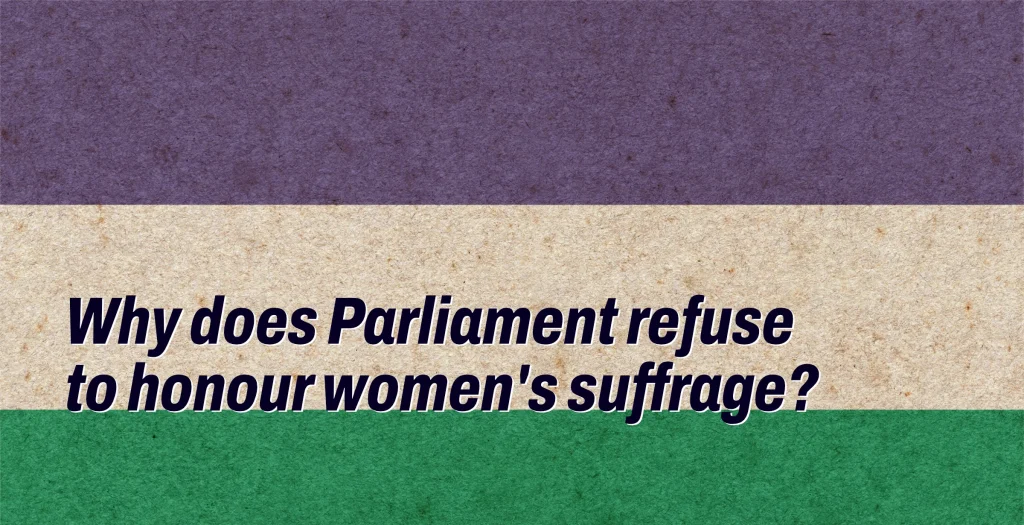
The purple, white and green suffrage flag (Suffrage Flag) was created by the UK Women’s Social and Political Union in 1908. The colours represent dignity (purple), purity (white) and hope (green).
Ms Ovens says the New Zealand women’s suffrage movement predated the Suffrage Flag. However, the UK Suffrage Flag has been widely used in New Zealand to mark and celebrate the momentous achievement of women winning the right to vote in 1893.
It was on 19 September in 1893 that Governor Lord Glasgow signed a new Electoral Act into law. The Government’s NZ History website celebrates the landmark legislation, as a result of which New Zealand became the first self-governing country in the world where women won the right to vote in parliamentary elections.
In most other democracies – including Britain and the United States – women did not win the right to the vote until after the First World War. New Zealand’s world leadership in women’s suffrage became a central part of our image as a trail-blazing ‘social laboratory’, the Government’s own website extolls.
The New Zealand women’s achievement did not come easily. Previous Bills to extend the vote to women in 1878, 1879 and 1887 narrowly failed to pass.
Undeterred, women responded by organising. Led by Kate Sheppard of the Women’s Christian Temperance Movement, suffrage campaigners collected thousands of signatures in 1891, 1892 and 1893 calling on Parliament to grant the vote to women. The largest of these had nearly 32,000 signatures, almost a quarter of the adult European female population at the time.
Opponents of women’s suffrage mobilised, warning that any disturbance of the ‘natural’ roles of men and women might have terrible consequences, including restrictions on the liquor industry.
The Suffragists responded with mass rallies and a flurry of telegrams to members. They also gave their supporters in Parliament white camellias to wear in their buttonholes.
The Government’s NZ History website says the idea that women could not or should not vote is “completely foreign to New Zealanders”. In 2023, 51% of our Members of Parliament were female, compared with 9% in 1981.
In the early 21st century women have held each of the country’s key constitutional positions: prime minister, governor-general, speaker of the House of Representatives, attorney-general and chief justice.
“Given that Suffrage Day is officially recognised as a ‘momentous’ achievement, what is the real reason behind the Speaker’s Office to refuse a perfectly reasonable request?” Ms Ovens asks.